Ashur (Qal'at Sherqat)
Factors affecting the property in 2008*
- Flooding
- Management systems/ management plan
- Water infrastructure
- Other Threats:
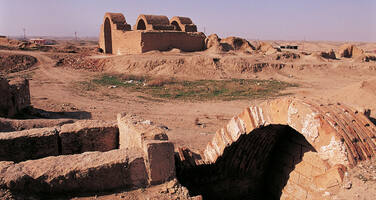
Fragile mud brick structures;
Factors* affecting the property identified in previous reports
a) Partial flooding and seepage due to a dam building project;
b) Fragile mud brick structures;
c) Absence of a comprehensive conservation and management plan.
Threats for which the property was inscribed on the List of World Heritage in Danger
- Nearby construction of a dam entailing partial flooding and seepage;
- State of war in the country.
Desired state of conservation for the removal of the property from the List of World Heritage in Danger
This will be defined as soon as the situation allows it.
Corrective Measures for the property
a) Relocation or cancellation of the dam project;
b) Emergency excavations and protective measures against seepage;
c) Establishment of a local management unit on the site;
d) Preparation and implementation of a conservation and management plan;
e) Protection and consolidation of fragile mud brick structures.
Timeframe for the implementation of the corrective measures
UNESCO Extra-Budgetary Funds until 2008
Total amount provided to the property: USD 6,000 from the Italian Funds-in-Trust
International Assistance: requests for the property until 2008
Total amount approved : 50,000 USD
| 2003 | Emergency assistance to prepare an urgent nomination of ... (Approved) | 50,000 USD |
Missions to the property until 2008**
November 2002: UNESCO mission
Conservation issues presented to the World Heritage Committee in 2008
On 12 February 2008, the World Heritage Centre received a report from the State Party, stating that the property had not suffered and had remained in good condition. However, as many other archaeological sites in Iraq, Ashur has suffered from trespassing, including illegal excavations. Nowadays, however, the property is well run by an administrative officer and a technical officer, and hosts a documentation and monitoring office. Regarding security, there are 12 full-time security guards as well as antiquities protection police stationed close to the archaeological site.
The report stresses that the property remains threatened, in particular by the high water levels and strength of the Tigris River, as some parts of the eastern side are collapsing, endangering the archaeological remains. The State Board of Antiquities and Heritage is consulting the Ministry of Water Resources in order to solve this problem, and requests the assistance of the international community to protect the property.
Given the situation in Iraq, no archaeological maintenance work was carried out, and as a result, many buildings require rapid intervention. Among these, the most important is the Tabira Gate: the brickwork was last restored in 1978, and there are many cracks in the Gate caused by torrential rainfalls. Furthermore, the ziggurat of the city and the walls of the palaces and temples are in poor condition due to climatic reasons.
The State Party has identified a series of priority and long term measures, both for the conservation and the presentation of the property, the most urgent one being to protect the eastern part of the site from seepage. The UNESCO mission of 2002 had proposed some solutions that could possibly be implemented. Maintenance, conservation and prevention work should be carried out. The report also mentions the need to cover the excavations dating from the 1990s or to backfill them.
The State Party also indicates in its report that a parking area has been defined and that visitors were channelled through a single entry. A guidebook and signs in Arabic and English have been completed.
The World Heritage Centre and the Advisory Bodies commend the State Party for the efforts which have been deployed to safeguard the property in the face of extreme challenges.
Summary of the interventions
Decisions adopted by the Committee in 2008
32 COM 7A.16
Ashur (Qal'at Sherqat) (Iraq) (C 1130)
The World Heritage Committee,
1. Having examined Document WHC-08/32.COM/7A,
2. Recalling Decision 31 COM 7A.17, adopted at its 31st session (Christchurch, 2007),
3. Notes with great concern the continuing difficult situation in Iraq and deplores the loss of human lives;
4. Requests the State Party to take possible emergency measures to protect the eastern part of the property from the rising waters of the Tigris River and to undertake necessary maintenance and conservation work to avoid further damage;
5. Encourages the State Party, should the situation allow it, to implement the corrective measures identified:
a) relocation or cancellation of the dam project;
b) emergency excavations and protective measures against seepage;
c) establishment of a local management unit on the site;
d) preparation and implementation of a conservation and management plan;
e) protection and consolidation of fragile mud brick structures.
6. Reiterates its requests to the State Party to develop, in consultation with the World Heritage Centre and the Advisory Bodies, a draft Statement of Outstanding Universal Value including the conditions of integrity and authenticity, and a proposal for the Desired state of conservation for the removal of the property from the List of World Heritage in Danger, for examination by the World Heritage Committee at its 33rd session in 2009;
7. Calls upon the international community to assist; in every way possible, the State Party in the protection of this property, with the advice of ICOMOS;
8. Requests the State Party, should the situation allow, to invite a joint World Heritage Centre/ICOMOS Reactive Monitoring mission to Ashur;
9. Further requests the State Party to submit to the World Heritage Centre by 1 February 2009 an updated report for examination by the World Heritage Committee at its 33rd session in 2009;
10. Decides to retain Ashur (Qal'at Sherqat) (Iraq) on the List of World Heritage in Danger.
Draft Decision: 32 COM 7A.16
The World Heritage Committee,
1. Having examined Document WHC-08/32.COM/7A,
2. Recalling Decision 31 COM 7A.17, adopted at its 31st session (Christchurch, 2007),
3. Notes with great concern the continuing difficult situation in Iraq and deplores the loss of human lives;
4. Requests the State Party to take possible emergency measures to protect the eastern part of the property from the rising waters of the Tigris River and to undertake necessary maintenance and conservation work to avoid further damage;
5. Encourages the State Party, should the situation allow it, to implement the corrective measures and initiate the preparation of a conservation and management plan for the property;
6. Reiterates its requests to the State Party to develop, in consultation with the World Heritage Centre and the Advisory Bodies, a draft Statement of outstanding universal value including the conditions of integrity and authenticity, and a proposal for the Desired state of conservationfor the removal of the property from the List of World Heritage in Danger,for examination by the World Heritage Committee at its 33rd session in 2009;
7. Calls upon the international community to assist the State Party in the protection of this property;
8. Further requests the State Party to submit to the World Heritage Centre by 1 February 2009 an updated report for examination by the World Heritage Committee at its 33rd session in 2009;
9. Decides to retain Ashur (Qal'at Sherqat) (Iraq) on the List of World Heritage in Danger.
 Iraq
Iraq
Exports
* :
The threats indicated are listed in alphabetical order; their order does not constitute a classification according to the importance of their impact on the property.
Furthermore, they are presented irrespective of the type of threat faced by the property, i.e. with specific and proven imminent danger (“ascertained danger”) or with threats which could have deleterious effects on the property’s Outstanding Universal Value (“potential danger”).
** : All mission reports are not always available electronically.