Humberstone and Santa Laura Saltpeter Works
Factors affecting the property in 2012*
- Deliberate destruction of heritage
- Management systems/ management plan
- Wind
- Other Threats:
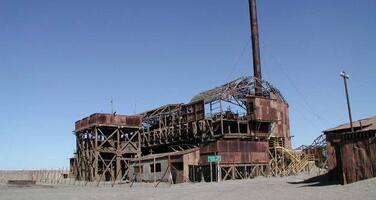
a) Extremely fragile nature of the industrial buildings that were constructed using local materials such as timber for frames, corrugated iron sheets for roofs and some walls, in addition to stucco and lightweight construction; b) Lack of maintenance over the past 40 years; c) Corrosion of metal cladding and dismantlement of some of the structural elements. A few buildings such as the Leaching House are liable to structural collapse if no support is given; d) Very little conservation work carried out
Factors* affecting the property identified in previous reports
a) Extremely fragile nature of the industrial buildings that were constructed using local materials such as timber for frames, corrugated iron sheets for roofs and some walls, in addition to stucco and lightweight construction;
b) Lack of maintenance over the past 40 years as well as vandalism at the property;
c) Corrosion of metal cladding and dismantlement of some of the structural elements. A few buildings such as the Leaching House are liable to structural collapse if no support is given;
d) Very little conservation work carried out;
e) Damage caused by the wind.
Threats for which the property was inscribed on the List of World Heritage in Danger
- Extremely fragile nature of the industrial buildings;
- Lack of maintenance for 40 years;
- Vandalism due to looting of re-usable materials;
- Damage caused by the wind.
Corrective Measures for the property
Not yet identified
International Assistance: requests for the property until 2012
Total amount approved : 60,000 USD
| 2012 | International Expert Meeting - Conservation of Wood ... (Approved) | 30,000 USD |
| 2007 | Protection and consolidation of the Humberstone and ... (Approved) | 30,000 USD |
Missions to the property until 2012**
October 2004: ICOMOS evaluation mission; May 2007: World Heritage Centre site visit; April 2010: Joint World Heritage Centre / ICOMOS reactive monitoring mission.
Conservation issues presented to the World Heritage Committee in 2012
The State Party submitted a state of conservation report on 8 February 2012 that responds to the requests made by the World Heritage Committee at its 35th session (UNESCO, 2011). No technical or graphic information on interventions was submitted with the report.
a) Implementation of the Priority Interventions Programme
The State Party’s report indicates that this programme continues slowly with resources from the State and that several agreements have been established with various agencies and academic bodies to assist with further work. The report also mentions the various activities carried out throughout 2011 at the property. These include the surveying of sites associated with the saltpetre outside of the property, but in close relation to the attributes of the World Heritage property and which will allow a better understanding of the inscribed area. The recovery of public lighting for Humberstone is in progress, with tender proposals being prepared as well as intervention proposals for various buildings. The definition of conservation criteria is expected to be concluded in 2012, and although progress has been made in surveying and recording, no specific conservation works or architectural stabilization interventions have been undertaken as yet. In its report, the State Party however indicates that restoration work will commence on the Head Doctor’s House in 2012, as well as the consolidation and refurbishing of the general store at Humberstone, which will be used as an interpretation centre, and that resources have been earmarked for 2012 for the consolidation of the Santa Laura Surgery.
b) International Expert Meeting
The report notes that in regard to the International Expert Meeting, the International Assistance request is being revised in response to comments made by the Advisory Bodies and that additional information is being compiled so as to have complete data sets by the time of the meeting. The World Heritage Centre received in March 2012 updated information from the State Party indicating the proposed dates of 21 – 26 October 2012 for the Expert Meeting. A programme was also attached on the proposed schedule of work. The State Party’s report indicates that it is awaiting the results of the analysis of materials from the site from the Deutsches Bergbau Museum of Bochum.
c) Reformulation of the Management Plan
The report indicates that the updated Management Plan was submitted in October 2011 to the National Monuments Council for its review, and is expected to be sent before June 2012 to the World Heritage Centre. The State Party has mentioned that plans for museology, security, safety, strategic management and marketing have been included in the Management Plan.
d) Establishment of the buffer zone
It is indicated that the revised Management Plan contains a specific programme for the establishment of the buffer zone through its inclusion under the National Monuments Act. No additional information is provided on this. At the 35th session of the World Heritage Committee, approval was given for a minor boundary modification and the State Party was asked to provide a map showing the revised boundary and buffer zone and its related regulations.
e) Desired state of conservation and timeframe for the implementation of corrective measures
The Desired state of conservation for the removal of the property from the List of World Heritage in Danger and the timeframe for implementation are to be developed by the State Party in consultation with the World Heritage Centre and the Advisory Bodies. The report notes that it will not be possible to comply with the timeframe previously established and that a revised timeframe can only be defined once processes underway have progressed and the required resources ensured. No Desired state of conservation has been submitted as yet. The World Heritage Centre and Advisory Bodies note that the results of the International Expert Meeting could assist the State Party in the elaboration of the Desired state of conservation and corrective measures.
f) Other issues
The report also indicates that the interpretation of the site has been identified as a priority, and funding has been provided through the National Tourism Board. A proposal for signposting at the property will be included in the Museology Plan currently being prepared. The World Heritage Centre and Advisory Bodies commend the allocation of resources for interpretation purposes, but would request the State Party to ensure that an adequate balance is achieved in the allocation of resources for visitation purposes and for integrated conservation programmes, critical to maintaining the property’s conditions of authenticity and integrity.
Analysis and Conclusion by World Heritage Centre and the Advisory Bodies in 2012
The World Heritage Centre and Advisory Bodies note the sustained efforts of the State Party in addressing the conditions that warranted the inscription of the property on the List of World Heritage in Danger. They note that the limited progress achieved to date is partially due to the challenges posed by the nature of the building materials, limited resources, as well as the time taken to develop adequate management arrangements. They recommend that the Committee urge the State Party to continue exploring means to secure the required resources to systematically implement the Priority Interventions Programme and the revised Management Plan so that significant progress can be achieved in the implementation of the corrective measures and the eventual removal of the property from the List of World Heritage in Danger.
Summary of the interventions
Decisions adopted by the Committee in 2012
36 COM 7A.33
Humberstone and Santa Laura Saltpeter Works (Chile) (C 1178)
The World Heritage Committee,
1. Having examined Document WHC-12/36.COM/7A,
2. Recalling Decision 35 COM 7A.32, adopted at its 35th session (UNESCO, 2011),
3. Acknowledges the information provided by the State Party on the implementation of identified corrective measures, and urges it to continue its efforts to secure the required resources for their full implementation;
4. Notes that the International Expert Meeting is scheduled for October 2012, and requests the State Party to take this opportunity to develop a draft Desired state of conservation for the removal of the property from the List of World Heritage in Danger, corrective measures, timeframe and its related financial estimation of costs, as well as a clear course of action to guide the property’s conservation strategy, to be submitted as part of the outcomes of the meeting, to be reviewed by the World Heritage Centre and the Advisory Bodies, for examination by the World Heritage Committee at its 37th session in 2013;
5. Also requests the State Party to ensure that an adequate balance is achieved in the allocation of resources for visitation purposes and for conservation programmes, critical to maintaining the property’s integrity;
6. Further requests the State Party to submit to the World Heritage Centre and the Advisory Bodies by October 2012, a copy of the Management Plan for the property;
7. Moreover requests the State Party to submit to the World Heritage Centre, by 1 February 2013, an updated report on the state of conservation of the property and the implementation of the above, for examination by the World Heritage Committee at its 37th session in 2013;
8. Decides to retain Humberstone and Santa Laura Saltpeter Works (Chile) on the List of World Heritage in Danger.
36 COM 8C.2
Establishment of the World Heritage List in Danger (Maintained Properties)
The World Heritage Committee,
1. Following the examination of the state of conservation reports of properties inscribed on the List of World Heritage in Danger (WHC-12/36.COM/7A and WHC-12/36.COM/7A.Add),
2. Decides to maintain the following properties on the List of World Heritage in Danger:
- Afghanistan, Minaret and Archaeological Remains of Jam (Decision 36 COM 7A.25)
- Afghanistan, Cultural Landscape and Archaeological Remains of the Bamiyan Valley (Decision 36 COM 7A.26)
- Belize, Belize Barrier Reef Reserve System (Decision 36 COM 7A.15)
- Central African Republic, Manovo-Gounda St Floris National Park (Decision 36 COM 7A.1)
- Chile, Humberstone and Santa Laura Saltpeter Works (Decision 36 COM 7A.33)
- Colombia, Los Katíos National Park (Decision 36 COM 7A.16)
- Côte d'Ivoire, Comoé National Park (Decision 36 COM 7A.2)
- Côte d'Ivoire / Guinea, Mount Nimba Strict Nature Reserve (Decision 36 COM 7A.3)
- Democratic Rep. of the Congo, Virunga National Park (Decision 36 COM 7A.4)
- Democratic Rep. of the Congo, Kahuzi-Biega National Park (Decision 36 COM 7A.5)
- Democratic Rep. of the Congo, Garamba National Park (Decision 36 COM 7A.6)
- Democratic Rep. of the Congo, Salonga National Park (Decision 36 COM 7A.7)
- Democratic Rep. of the Congo, Okapi Wildlife Reserve (Decision 36 COM 7A.8)
- Egypt, Abu Mena (Decision 36 COM 7A.20)
- Ethiopia, Simien National Park (Decision 36 COM 7A.9)
- Georgia, Bagrati Cathedral and Gelati Monastery (Decision 36 COM 7A.30)
- Georgia, Historical Monuments of Mtskheta (Decision 36 COM 7A.31)
- Honduras, Río Plátano Biosphere Reserve (Decision 36 COM 7A.17)
- Indonesia, Tropical Rainforest Heritage of Sumatra (Decision 36 COM 7A.13)
- Iraq, Ashur (Qal'at Sherqat) (Decision 36 COM 7A.21)
- Iraq, Samarra Archaeological City (Decision 36 COM 7A.22)
- Islamic Republic of Iran, Bam and its Cultural Landscape (Decision 36 COM 7A.27)
- Jerusalem, Old City of Jerusalem and its Walls (Decision 36 COM 7A.23.I)
- Madagascar, Rainforests of the Atsinanana (Decision 36 COM 7A.10)
- Niger, Air and Ténéré Natural Reserves (Decision 36 COM 7A.11)
- Peru, Chan Chan Archaelogical Zone (Decision 36 COM 7A.34)
- Senegal, Niokolo-Koba National Park (Decision 36 COM 7A.12)
- Serbia, Medieval Monuments in Kosovo (Decision 36 COM 7A.32)
- United Rep. of Tanzania, Ruins of Kilwa Kisiwani and Ruins of Songo Mnara (Decision 36 COM 7A.19)
- Uganda, Tombs of Buganda Kings at Kasubi (Decision 36 COM 7A.18)
- United States of America, Everglades National Park (Decision 36 COM 7A.14)
- Venezuela, Coro and its Port (Decision 36 COM 7A.35)
- Yemen, Historic Town of Zabid (Decision 36 COM 7A.24)
Draft Decision: 36 COM 7A.33
The World Heritage Committee,
1. Having examined Document WHC-12/36.COM/7A,
2. Recalling Decision 35 COM 7A.32, adopted at its 35th session (UNESCO, 2011),
3. Acknowledges the information provided by the State Party on the implementation of identified corrective measures, and urges it to continue its efforts to secure the required resources for their full implementation;
4. Notes that the International Expert Meeting is scheduled for October 2012, and requests the State Party to take this opportunity to develop a draft Desired state of conservation for the removal of the property from the List of World Heritage in Danger, corrective measures, timeframe and its related financial estimation of costs, as well as a clear course of action to guide the property’s conservation strategy, to be submitted as part of the outcomes of the meeting, to be reviewed by the World Heritage Centre and the Advisory Bodies, for examination by the World Heritage Committee at its 37th session in 2013;
5. Also requests the State Party to ensure that an adequate balance is achieved in the allocation of resources for visitation purposes and for conservation programmes, critical to maintaining the property’s integrity;
6. Further requests the State Party to submit to the World Heritage Centre and the Advisory Bodies by October 2012, a copy of the Management Plan for the property;
7. Moreover requests the State Party to submit to the World Heritage Centre, by 1 February 2013, an updated report on the state of conservation of the property and the implementation of the above, for examination by the World Heritage Committee at its 37th session in 2013;
8. Decides to retain Humberstone and Santa Laura Saltpeter Works (Chile) on the List of World Heritage in Danger.
 Chile
Chile
Exports
* :
The threats indicated are listed in alphabetical order; their order does not constitute a classification according to the importance of their impact on the property.
Furthermore, they are presented irrespective of the type of threat faced by the property, i.e. with specific and proven imminent danger (“ascertained danger”) or with threats which could have deleterious effects on the property’s Outstanding Universal Value (“potential danger”).
** : All mission reports are not always available electronically.