Megalithic Temples of Malta
Factors affecting the property in 2005*
- Deliberate destruction of heritage
- Housing
- Illegal activities
- Interpretative and visitation facilities
- Solid waste
Factors* affecting the property identified in previous reports
- Vandalism;
- Proposal for interim landfills for domestic waste near the Temples of Hagar Qim and Mnajdra in Qrendi;
- Illegal construction of houses close to the Ggantija Temple;
- International Competition for a Ħaġar Qim and Mnajdra Heritage Park.
International Assistance: requests for the property until 2005
Total amount approved : 74,073 USD
| 1998 | Emergency Assistance for Hagar Qim, Megalithic Temples, ... (Approved) | 72,448 USD |
| 1981 | 2-week consultant mission to advise on setting up a ... (Approved) | 1,625 USD |
Missions to the property until 2005**
UNESCO mission 1994, ICOMOS mission 2001;
Conservation issues presented to the World Heritage Committee in 2005
A detailed updated report on the Project for a Heritage Park and the Development Plan was sent to the World Heritage Centre on 29 January 2005.
This report indicates that extensive security measures were put in place in 2001. The State Party is pleased to report that since then there have been no instances of vandalism to the Megalithic Temples. No illegal building works affecting the Temples or the Park have taken place since 2001. The apparent discrepancy here is attributable to the fact that the comments reported to the Committee in 2004 referred to the Ġgantija Temple on the Island of Gozo, whilst the Archaeological Park is confined to the Hagar Qim and Mnajdra Temples.
The report recapitulates the details of the proposed Park, presented to the Committee at its 28th session (Suzhou, 2004). These are updated by a report on the International Design Competition held in 2004 (won by Walter Hunziker of Berne, Switzerland). The original design brief was amended following examination by the Technical Committee and the Competition Jury. A visitor survey and a feasibility study have been undertaken, providing further information on the present and anticipated visitor needs at the property. A single building to welcome visitors to the property is now being projected, instead of the two buildings in different parts of the landscape originally indicated in the competition design brief. The visitor centre is being proposed at the property indicated by the Jury as the ideal location, namely, the existing parking area. The scale of visitor facilities being projected has been reduced significantly.
The report draws the attention to the following points:
The decision to shelter Hagar Qim and Mnajdra was adopted by the State Party on the recommendations made by the Scientific Committee for the Conservation of the Megalithic Temples in 2000, and is fully endorsed by ICOMOS Malta. Studies by the Scientific Committee came to the conclusion that protective sheltering would significantly mitigate the deterioration processes that are presently threatening the monuments, and that sheltering is presently the best and safest medium-term option, while research continues on alternative treatments in the longer term. The protective shelters are designed as a temporary measure with a lifetime of 30 years, with minimal impact on the ground, and can be completely removed. The visual intrusion caused by the shelters is considered justified by (i) the fulfilment of the responsibility to pass on the monuments to future generations and (ii) its reversibility. The shelters are being planned in the context of an intensive environmental programme to monitor their performance and to allow comparison with the situation before their installation.
High priority is being given to the development of Management Plans. Heritage Malta is working with English Heritage and the Wiltshire County Council (UK) as part of the Centurio Project co-funded by the Interreg IIIC Programme of the European Union. Four seminars were held in October 2004; participants included planners, heritage managers, archaeologists and other key stakeholders. A strategy being developed to allow the six Megalithic properties, which vary considerably in extent, preservation, setting, management context, etc, to be covered by a single Management Plan. In addition to general conservation issues, other issues that are being dealt with on a property-specific basis include visitor flow and carrying capacity; documentation, landscape management, etc.
Considerable progress has been made over the past year in the complex process of drafting a Management Plan for six properties (seven Megalithic Temples) that differ considerably in a number of aspects.
Summary of the interventions
Decisions adopted by the Committee in 2005
29 COM 7B.80
The Megalithic Temples of Malta (Malta)
The World Heritage Committee,
1. Having examined Document WHC-05/29.COM/7B.Rev,
2. Recalling its Decision 28 COM 15B.76, adopted at its 28th session (Suzhou, 2004),
3. Thanks the State Party of Malta for the reports provided concerning the conservation of the World Heritage property and on the project for a Heritage Park,
4. Congratulates the State Party on the considerable progress that has been made over the past year in the complex process of drafting a Management Plan for six properties;
5. Requests the State Party to provide to the World Heritage Centre complementary information on Management Plan drafting, as well as on the project for a Heritage Park;
6. Further requests the State Party to provide the World Heritage Centre with a detailed report on the Megalithic Temples, including information about illegal structures close to the Ggantija Temple on Gozo by 1 February 2007 for examination by the Committee at its 31st session (2007).
Draft Decision: 29 COM 7B.80
The World Heritage Committee,
1. Having examined Document WHC-05/29.COM/7B.Rev,
2. Recalling its Decision 28 COM 15B.76, adopted at its 28th session (Suzhou, 2004),
3. Thanks the State Party for the reports provided concerning the conservation of the World Heritage property and on the project for a Heritage Park ,
4. Congratulates the State Party on the considerable progress that has been made over the past year in the complex process of drafting a Management Plan for six properties;
5. Requests the State Party to provide to the World Heritage Centre complementary information on Management Plan drafting, as well as on the project for a Heritage Park;
6. Further requests the State Party to provide the World Heritage Centre with a detailed report on the Megalithic Temples, including information about illegal structures close to the Ggantija (Ġgantija)Ttemple on Gozo by 1 February 2007 for examination by the 31st session of the World Heritage Committee in 2007.
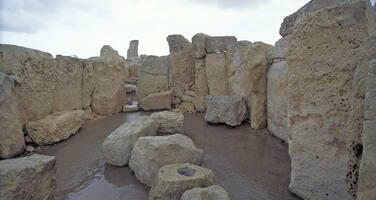
 Malta
Malta
* :
The threats indicated are listed in alphabetical order; their order does not constitute a classification according to the importance of their impact on the property.
Furthermore, they are presented irrespective of the type of threat faced by the property, i.e. with specific and proven imminent danger (“ascertained danger”) or with threats which could have deleterious effects on the property’s Outstanding Universal Value (“potential danger”).
** : All mission reports are not always available electronically.